
You’re scrolling through another ad. A polished video shows someone next to a wall of vending machines, promising financial freedom through their proven system. The testimonials look real. The curriculum seems comprehensive. The price is steep but “investment in yourself,” right?
Here’s the truth: most vending machine course purchases end in quiet disappointment. Not because the information is wrong—though some of it is—but because information alone doesn’t create competence. You can watch 40 hours of modules and still freeze when a location manager demands different contract terms than what the course taught. You can memorize placement strategies and still have no idea why your “ideal” location is underperforming.
The vending industry is flooded with courses promising shortcuts to success. Some offer genuine value. Most sell reassurance disguised as education. The difference isn’t always obvious from the sales page, but it becomes painfully clear three months after purchase when you’re stuck with a problem the modules didn’t cover and no one to ask.
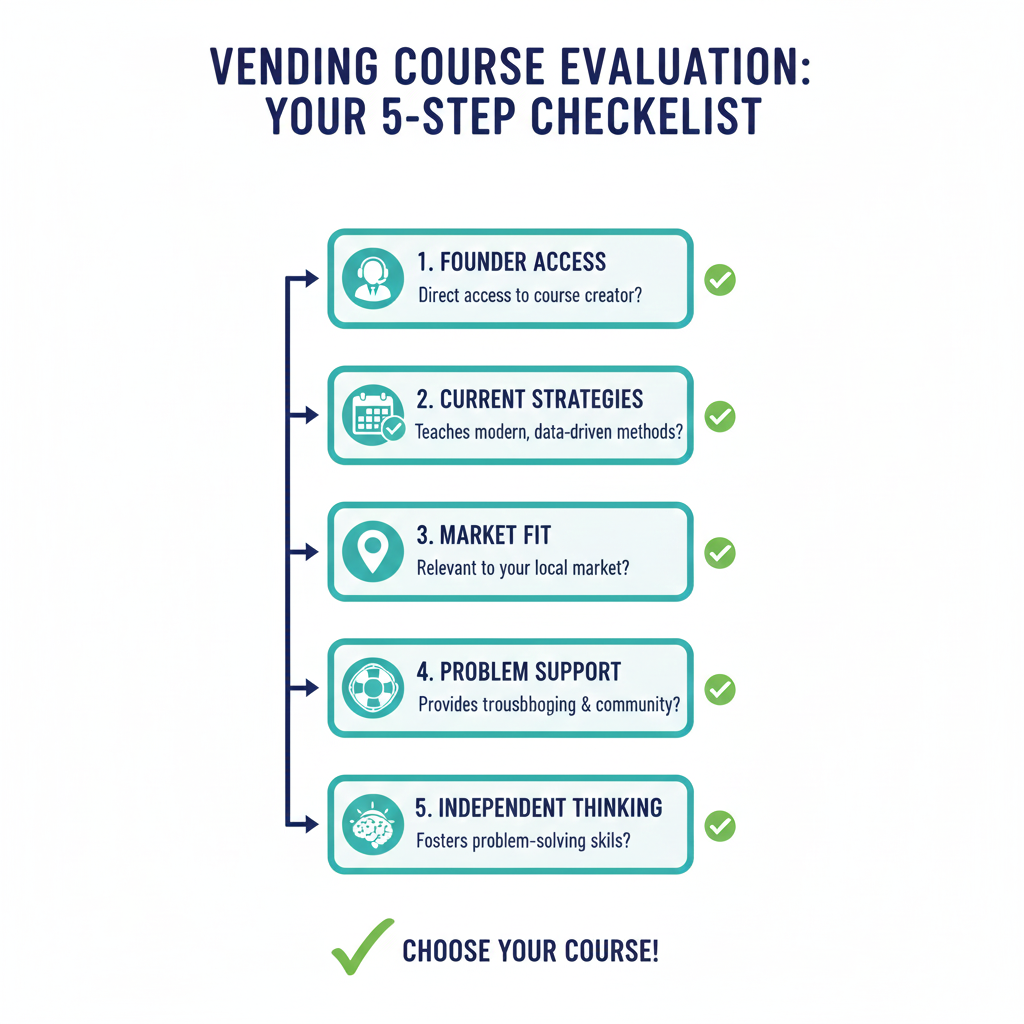
This article walks you through five essential questions to ask before spending another dollar on a vending machine course. These aren’t about checking feature lists—they’re about identifying whether you’re buying real mentorship or just expensive videos.
This is the question that separates education from entertainment.
Before purchasing any vending course, evaluate whether it offers real access to the person who built the system. Information alone does not create competence—proximity does. The difference between theoretical guidance and operational power is the ability to ask situational questions when reality breaks the script: a location demanding new terms, a freezer failing in humidity, a placement falling through after weeks of follow-up.
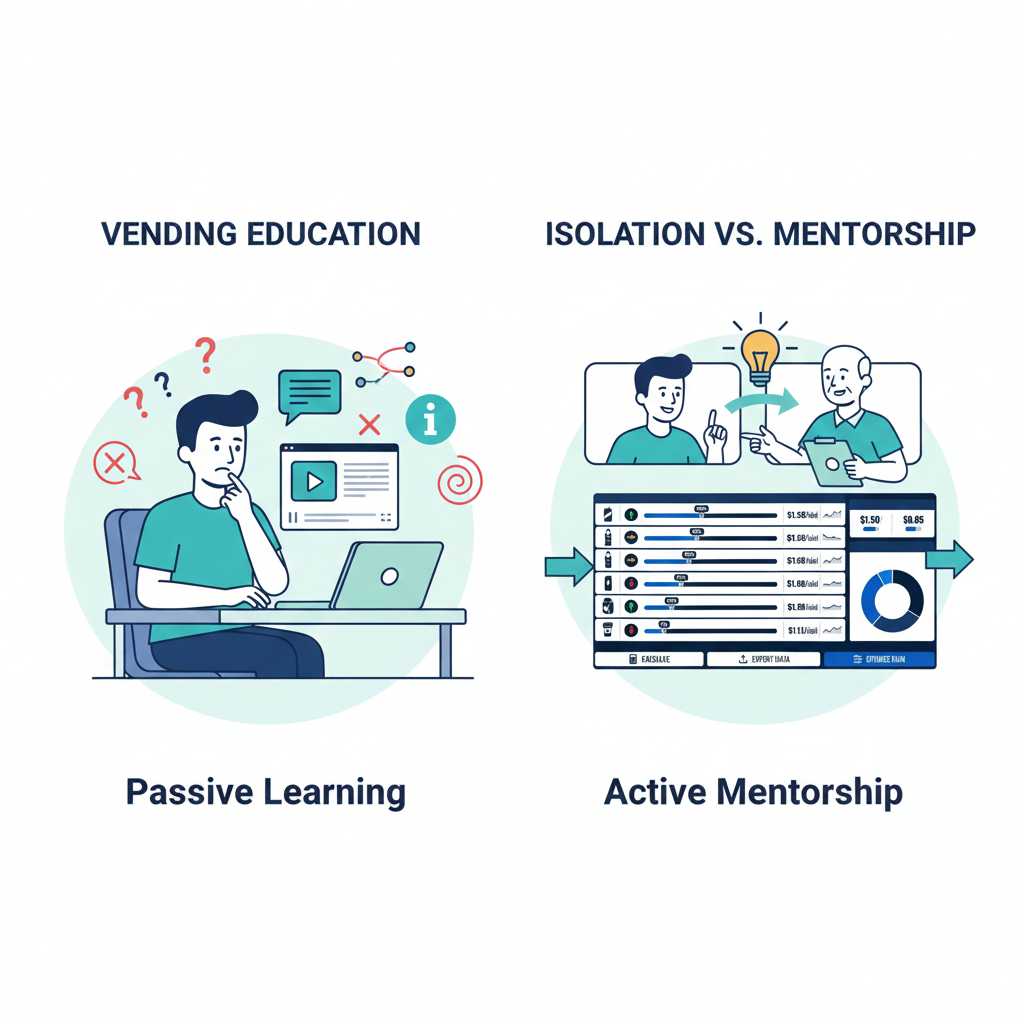
Courses that scale prerecorded modules without sustained founder interaction are not selling education—they’re selling reassurance. They’re betting you’ll feel productive watching videos while avoiding the actual work of building a vending business. And when you inevitably hit obstacles the curriculum didn’t anticipate, you’re left with no recourse except rewatching the same generic advice that didn’t help the first time.
“The true value of mentorship is not the curriculum; it is the founder’s judgment, pattern recognition, and real-time correction—and without access to that source, even the best-designed program will deliver only a fraction of its promise.”
What “real access” actually looks like:
Research from the Journal of Business Education shows that entrepreneurship students with direct mentor access achieve 67% higher revenue in their first year compared to those relying solely on structured curriculum without personalized guidance.
Red flags that indicate no real access:
Ask specifically: “How many hours per month will I have direct access to you? What’s your typical response time to student questions? Can I see examples of how you’ve helped students solve unexpected problems?”
If the answer is vague or points you toward “comprehensive modules,” that’s not a vending machine course—it’s a video library with a high price tag.
Vending operations change. Regulations shift. Technology advances. Supplier relationships evolve. A vending operator course that was cutting-edge in 2019 might teach strategies that actively harm you in 2025.
The critical question: Is the course creator still operating vending machines right now using these exact methods?
Many course creators built successful vending businesses, then retired from operations to teach full-time. That’s not automatically disqualifying—experience matters. But it creates a dangerous gap: they’re teaching what worked for them five years ago, not what works in today’s market conditions.
For example:
A study from the National Automatic Merchandising Association (NAMA) found that operational strategies in vending have changed more in the past 3 years than in the previous 10, primarily due to smart technology adoption and shifting workplace patterns.
How to verify current operational relevance:
“The best vending machine course isn’t taught by someone who succeeded once—it’s taught by someone who’s succeeding now, repeatedly, using the exact methods they’re teaching.”
Warning sign: Course creator’s LinkedIn shows they haven’t actively operated vending machines in 3+ years, but they’re still selling “proven systems” without acknowledging market evolution.

Not all vending markets are the same. A vending education program that works brilliantly for operators in dense urban areas might be completely irrelevant for someone building routes in rural regions. Strategies optimized for corporate offices don’t transfer to manufacturing facilities. Approaches that succeed in warm climates fail in areas with extreme temperature swings.
Generic courses pretend geography and market type don’t matter. Quality courses acknowledge they absolutely do.
Before investing in any vending machine course, ask: “Does this address my specific market context, or am I expected to figure out the translation myself?”
Market variables that demand different strategies:
A case study from Cornell’s School of Hotel Administration showed that vending operators who adapted strategies to their specific market context achieved 34% higher profit margins than those applying generic “best practices” without localization.
Questions to ask course creators:
Red flag: Course markets itself as “works anywhere for anyone” without acknowledging that context matters. Real operational expertise recognizes nuance.
If the vending course can’t articulate how strategies adapt to different market realities, you’re not buying expertise—you’re buying theory that might not survive contact with your actual business environment.
This is where most courses fail silently.
No curriculum, no matter how comprehensive, can anticipate every operational challenge you’ll face. The real test of a vending machine course isn’t what it teaches—it’s how it supports you when reality diverges from the lesson plan.
Scenarios courses rarely prepare you for:
These aren’t edge cases—they’re normal business operations. The question is: when they happen to you, does your course creator have your back, or are you on your own?
Research from the Kauffman Foundation on entrepreneurship education found that access to real-time problem-solving support was the #1 predictor of student success—more important than curriculum quality, community size, or even total content hours.
What quality support actually includes:
Ask directly: “Tell me about a time a student faced a problem not covered in your course. How did you help them? Can I talk to that student?”
If the course creator can’t articulate how they handle unexpected situations—or worse, insists their curriculum covers “everything you’ll ever need”—that’s a fantasy, not education.
“The value of a vending machine course reveals itself not in what it teaches you to expect, but in how it helps you navigate what you didn’t.”
The most insidious type of low-quality vending operator course isn’t one that teaches wrong information—it’s one that teaches you to be dependent.
Bad courses create followers. Good courses create operators who can reason independently.
Here’s how to spot the difference: Does the course explain why strategies work, or just what to do? Can you apply the underlying principles to new situations, or are you lost the moment circumstances deviate from the script?
Teaching you to think looks like:
Teaching you to follow looks like:
A study from MIT Sloan Management Review on business education found that entrepreneurs who learned decision frameworks outperformed those who memorized specific tactics by 41% when facing novel business challenges.
Questions that reveal teaching quality:
Warning sign: Course heavily emphasizes “just follow our proven system exactly” without explaining the reasoning behind decisions. This creates fragile operators who collapse when reality doesn’t match the template.
The best vending machine course doesn’t just give you a playbook—it teaches you to write your own based on sound operational principles. If you finish the program and still can’t explain why you’re making the decisions you’re making, you’ve been trained, not educated.
Before purchasing any vending machine course:
Red flags that should stop you from buying:
Here’s what experienced operators know: the right vending machine course doesn’t feel like buying information—it feels like gaining a guide who’s still in the trenches with you.
You’re not paying for videos. You’re paying for access to someone who’s solved the problems you’re about to face and can help you navigate them in real-time. You’re paying for judgment, pattern recognition, and the ability to ask “what would you do in this exact situation?” when your specific circumstances don’t match the textbook.
The vending industry has room for both self-taught operators and those who accelerate through mentorship. But mentorship only works when it’s actual mentorship—not prerecorded reassurance disguised as education.
Before you invest another dollar in a vending operator course, ask these five questions. Really ask them. Demand specific answers. If the course creator gets defensive or vague, that tells you everything you need to know.
The operators building sustainable, profitable vending businesses aren’t the ones who bought the most courses. They’re the ones who found one mentor worth learning from and then did the work. Sometimes that mentor is free (experience, trial and error, community knowledge). Sometimes it’s worth paying for. But it’s never worth paying for something that can’t help you when you’re stuck.
What vending machine course are you considering? Have you asked these five questions yet? Take the time to evaluate properly. Your business—and your bank account—will thank you.
The right education doesn’t just teach you how to start a vending business. It teaches you how to think like a vending operator who can solve problems independently, adapt to changing conditions, and build something genuinely profitable. That’s worth investing in. Everything else is just noise.
If you are starting out and want to avoid some pitfalls, you may also like to read these blogs:
7 Reasons Delegating Too Early Is the Most Expensive Mistake New Founders Make
How I Landed My First Location With Zero Proof
The Passive Income Vending Machine Myth: 5 Hard Truths