
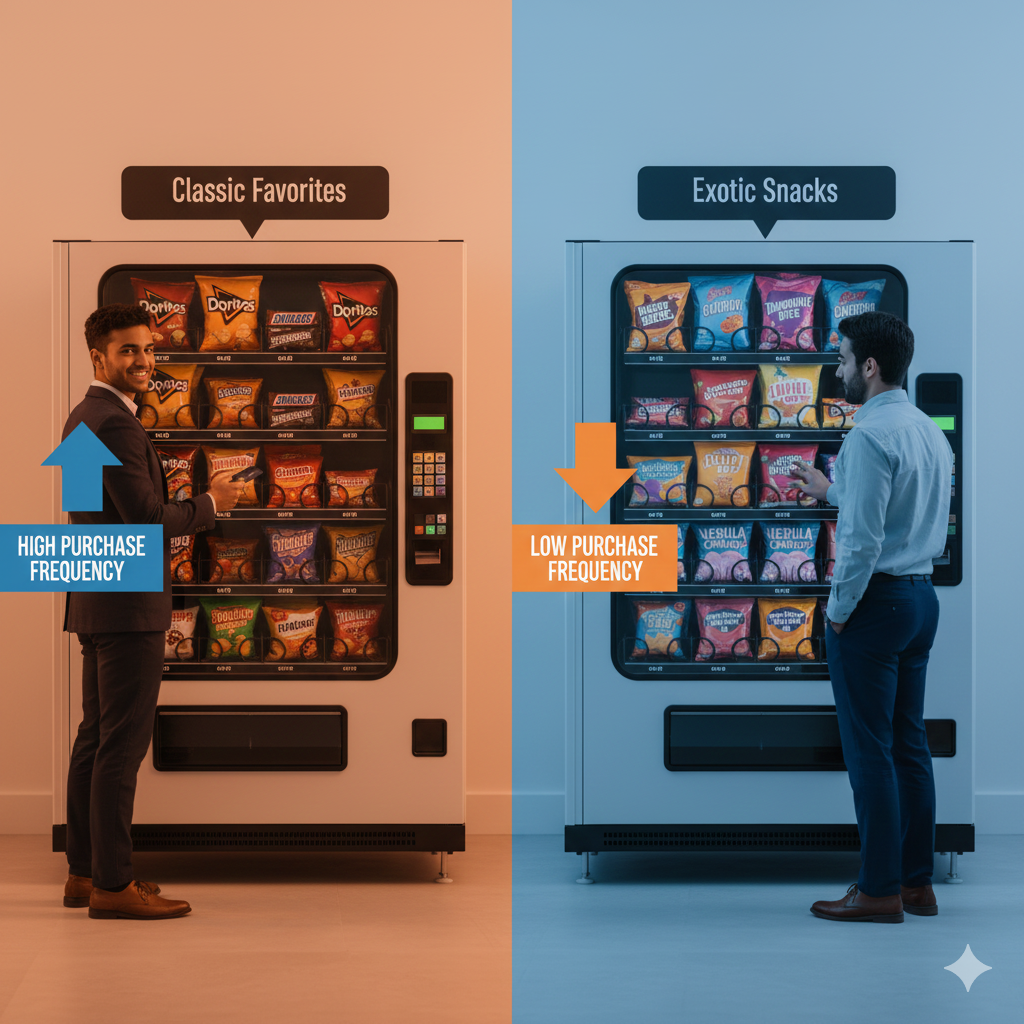
Here’s something that might surprise you: that unique, exotic flavor you’re excited to stock? It’s probably going to sit there while the Classic Lay’s next to it flies off the shelf. And before you think this means vending is boring or that customers lack adventure—stick with me. Understanding why vending machine sales favor familiarity over flavor innovation isn’t limiting; it’s liberating. It’s the key to building a profitable, sustainable business that actually serves your customers well.
The psychology behind vending machine purchases is fascinating, and once you understand it, you’ll make better inventory decisions that boost your revenue while keeping customers happy. Let’s dive into why familiar beats flavor in Vending Machine sales and more importantly, how you can use this insight to grow your business.
Think about the last time you bought something from a vending machine. How long did you stand there deciding? Probably not long, right?
Research shows that the average vending machine transaction takes just 8-12 seconds from approach to selection. That’s it. You’ve got less time than a YouTube pre-roll ad to capture attention, inspire confidence, and close the sale. In those precious seconds, customers aren’t looking for culinary adventure—they’re looking for comfort and certainty.
Here’s what happens in those 8 seconds:
“Vending isn’t a discovery platform—it’s a reliability platform. Customers trade exploration for certainty.”
When someone encounters an unfamiliar snack, their brain has to work harder. What does this taste like? Is it worth the risk? What if I don’t like it? Each question adds cognitive load. Each moment of uncertainty increases the chance they’ll just… walk away. Or worse, pick the familiar option right next to your exotic experiment.
What does this mean for your vending machine sales? Simple: familiarity removes friction. And in a business where convenience is king, friction is your enemy.
Let’s talk about what’s actually happening in your customer’s brain when they stand in front of your machine. Neuroscientists call it “cognitive ease”—the brain’s preference for information that’s easy to process.
According to behavioral research from the Journal of Consumer Psychology, familiar products trigger 3-4 times faster decision-making than unfamiliar alternatives. When customers see brands they know—Snickers, Doritos, Coca-Cola—their brain doesn’t have to evaluate. It just confirms and acts.
This isn’t about customers being lazy or uncreative. It’s about how our brains are wired for efficiency. Think about it: you make thousands of decisions every day. Your brain conserves energy by automating the easy ones. Vending machine purchases? That’s an easy one—if you stock familiar options.
The data backs this up:

Here’s the good news: this isn’t a limitation—it’s a framework for success. Once you accept that vending machine sales psychology favors familiarity, you can stop guessing and start optimizing.
Instead of constantly experimenting with new products (expensive, time-consuming, risky), you can focus on:
1. Stocking proven performers consistently
When customers know they can rely on your machines for their favorites, they return. Reliability builds reputation. Reputation builds route density. Route density builds profit.
2. Reducing decision fatigue for your customers
A machine with 30 familiar options performs better than one with 20 familiar + 10 experimental items. Why? Because familiar options don’t compete—they complement. Each slot filled with a known quantity increases overall confidence in the machine.
3. Improving your inventory turnover
Familiar items move faster, which means fresher product, less waste, and better margins. You’re not gambling on whether that artisanal kale chip will sell before it expires.
“The best vending operators don’t fight consumer psychology—they work with it. Familiar inventory isn’t boring; it’s profitable.”
Does this mean never trying anything new? Not at all. It means being strategic about innovation. The 80/20 rule works beautifully here: 80% familiar foundations, 20% experimentation. Your core inventory should be rock-solid familiar brands. Your experimental slots should be just that—strategic tests, not hopeful gambles.
Let’s be honest about what happens when you stock that exciting new snack nobody’s heard of:
Slower sales cycles: It sits there while familiar items around it sell out. You visit the machine, the exotic item is still there. Next visit? Still there. Now it’s close to expiration.
Higher spoilage rates: Unfamiliar items expire before selling, especially perishable or niche products. That’s pure loss.
Opportunity cost: Every slot occupied by a slow-moving exotic item is a slot that could hold a fast-moving familiar product. If Snickers turns 3x per week and your artisanal energy bar turns once per month, you’re leaving money on the table.
Customer disappointment: When someone approaches your machine hoping for their reliable favorite and finds it sold out—replaced by something unfamiliar—they feel let down. They might not buy at all. That’s a failed transaction that hurts your vending machine sales metrics.
A study from Automatic Merchandiser found that vending machines with 85%+ familiar brand coverage saw 34% higher revenue compared to machines with 50-60% familiar brand coverage. The math is clear: familiarity drives frequency, and frequency drives revenue.
Ready to optimize your machines using familiarity as your guide? Here’s your roadmap:
Before we get into the action steps, let’s crystallize what matters most:
Step 1: Audit Your Current Inventory (Week 1)
Walk through your machines and categorize each product as “Familiar Brand” (nationally recognized), “Regional Familiar” (known locally), or “Unknown/Experimental.” Calculate your familiarity ratio. If you’re below 75% familiar brands, you’ve found your growth opportunity.
Step 2: Identify Your Core 15-20 Products (Week 1-2)
These are your foundation. Think: Coca-Cola, Pepsi, Mountain Dew, Snickers, Doritos, Lay’s Classic, Cheetos, Snickers, Reese’s, KitKat. Products that anyone walking up to your machine would recognize instantly. These should occupy 75-85% of your slots.
Step 3: Create Your Innovation Zone (Week 2)
Reserve 15-25% of slots for testing. This is where you can try regional favorites, seasonal items, or trending products. But treat it as a test zone with clear performance metrics. If something doesn’t turn at least once per week, rotate it out.
Step 4: Track Performance by Category (Ongoing)
Create a simple spreadsheet: Product name, familiar vs. experimental, turns per week, revenue per slot. Review monthly. Let the data guide your decisions. You’ll quickly see familiar products pulling their weight.
Step 5: Communicate Reliability to Customers (Ongoing)
If you manage the locations, consider subtle signage: “Your Favorites, Always Stocked.” Consistency builds trust. Trust builds loyalty. Loyalty builds sustainable vending machine sales growth.
Step 6: Restock Familiar Items First (Every Service Visit)
When you service machines, prioritize refilling sold-out familiar items before adding experimental products. Never let a familiar favorite go empty while experimental items remain stocked.
As you think about your vending machine sales strategy, consider:
What percentage of my current inventory would a stranger immediately recognize? If it’s less than 75%, you have a clear path to improvement.
Am I stocking products I personally find interesting, or products that data shows customers actually buy? There’s a difference between what excites us as operators and what drives consistent sales.
When was the last time I rotated out an experimental product that wasn’t performing? Holding onto hope costs money. Let the numbers guide you.
Here’s what’s exciting about understanding why familiar beats flavor: you now have a framework for sustainable success. You’re not guessing anymore. You’re not hoping that trendy new snack will catch on. You’re building your business on the solid foundation of consumer psychology and proven performance.
Does this mean vending is boring? Absolutely not. It means vending is reliable—for you and your customers. And reliability is what builds thriving businesses.
Your customers aren’t coming to your machine for culinary exploration. They’re coming for quick, confident access to what they know and love. When you deliver that consistently, something beautiful happens: they come back. Again and again. That’s not boring—that’s the foundation of recurring revenue.
“Success in vending isn’t about introducing customers to new flavors. It’s about being the reliable source for the flavors they already love.”
The vending operators who thrive aren’t the ones constantly chasing the next exotic product trend. They’re the ones who deeply understand their customers’ desire for familiarity and build their inventory strategy around that truth. They stock familiar brands, maintain consistent availability, and use data to refine their core offerings.
You can be one of those operators. Start with your next restock: prioritize the familiar, test strategically, and track everything. Your vending machine sales data will tell you the story. And I’m betting it’s going to confirm what the research shows—familiar beats flavor, every single time.
You’ve got this. Now go fill those machines with confidence, knowing exactly why those classic snacks are your best business partners.
Would like to know what the evidence says about the most popular snacks and drinks in Maryland? Read these posts:
Top 5 Maryland Vending Machine Drinks That Drive Sales
Top 5 Snack Items in Maryland Vending Machines