

The vending industry is obsessed with the wrong problem. Every conference panel, every trade magazine, every operator forum discusses payment modernization as if accepting Apple Pay solves the fundamental challenge of micro-retail. It doesn’t.
Frictionless vending isn’t about removing cash—it’s about removing every unnecessary touchpoint between customer intent and product delivery. The future belongs to operators who understand that friction compounds across the entire transaction chain, and cashless payments only address one friction point among dozens.
Cash versus digital is a payment method debate. Friction versus frictionless is an operational systems debate. One is tactical. The other is existential.
“In micro-retail, every second of customer interaction is a compounding tax on conversion. The question isn’t what they pay with—it’s how many decision points they must clear before completion.”
Friction is any point where customer momentum toward purchase stalls, reverses, or requires conscious decision-making. In traditional retail, friction is often desirable—consultative sales, product education, customer service interactions. In micro-retail, friction is purely extractive.
Consider the friction map of a typical vending transaction:
Physical Friction Points:
Cognitive Friction Points:
Temporal Friction Points:
A 2023 study by the National Automatic Merchandising Association found that average transaction times in modern vending machines range from 35 to 180 seconds depending on payment method and product category. But transaction time only measures observable friction. The invisible friction—the walk-away rate from customers who evaluate and reject a purchase before even approaching—remains unmeasured by most operators.
Think about your highest-traffic location. How many potential customers evaluate your machine daily but never initiate a transaction? That’s friction you can’t see in your sales data.
The industry treats cashless payment as the pinnacle of vending modernization. The logic seems sound: credit cards and mobile payments are faster than cash, so cashless machines must be more efficient.
This conflates payment speed with operational friction. Cashless payment reduces one specific friction point (payment processing time) while potentially introducing others:
New Friction Points from Cashless Systems:
Research from Vending Market Watch indicates that cashless-enabled machines experience 12-18% higher transaction values but also report 23-31% higher technical support calls related to payment processing failures. The friction hasn’t disappeared—it has migrated.
A truly frictionless vending system doesn’t optimize payment method. It questions whether explicit payment interaction is necessary at all.
The principle: Reducing transaction friction means reducing total touchpoints, not optimizing individual touchpoints. A cashless system that requires four interactions is still higher-friction than a cash system that requires two.
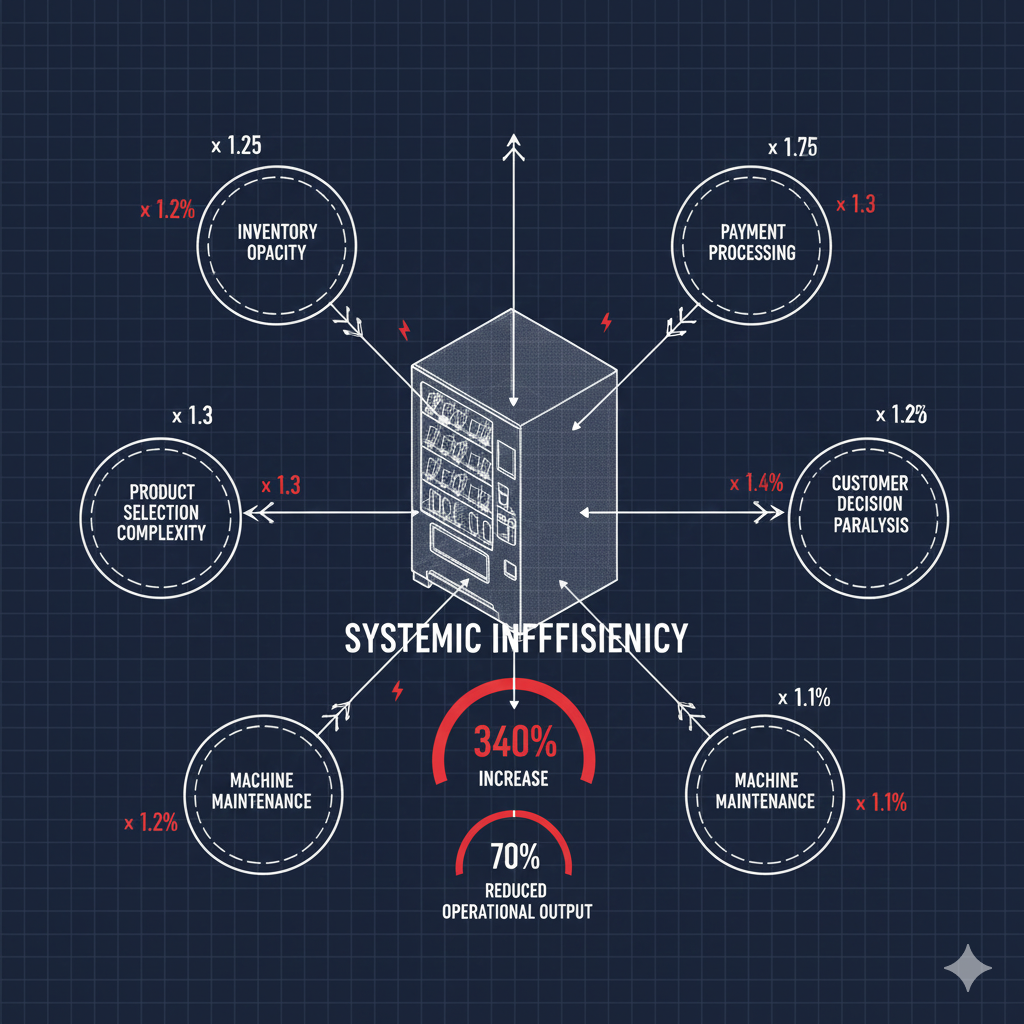
Some friction points don’t just slow transactions—they multiply across your entire operation, creating cascading inefficiency that compounds over time.
When customers can’t immediately identify what you stock or whether their preferred product is available, they either conduct a visual inventory audit (adding 15-30 seconds to transaction time) or walk away. Smart coolers with digital transparency eliminate this friction by making inventory status instantly visible, but traditional vending requires the customer to physically inspect each column.
The Harvard Business Review’s research on retail friction points found that product discovery uncertainty increases abandonment rates by 34% in self-service retail environments. In vending, this manifests as the customer who walks up, peers through glass for 8 seconds, and leaves without engaging.
Alphanumeric selection codes (A3, B7, etc.) create cognitive load. The customer must:
This five-step process introduces failure points at each stage. Modern touchscreen interfaces reduce this to two steps (tap product, confirm), cutting selection friction by 60%.
The customer needs confirmation that:
Traditional vending addresses none of these proactively. The customer must trust based on machine appearance and brand reputation. Frictionless micro-retail eliminates trust friction by providing real-time status indicators, inventory confirmation before payment, and automated refund systems that don’t require customer service calls.
According to Convenience Store News, vending machines with visible operational status displays and inventory transparency see 28% higher conversion rates than identical machines without these features. The product selection hasn’t changed—the friction has been removed from the decision-making process.
The frictionless vending future isn’t incremental improvement—it’s architectural redesign around a single principle: minimize total customer touchpoints while maximizing conversion certainty.
Digital Inventory Transparency: Customers know what’s available before approaching the machine. Smart coolers with glass doors showing real-time stock status eliminate the discovery friction entirely. The customer’s decision is made visually before any physical interaction.
Dynamic Pricing Displays: Clear, visible pricing removes the evaluation friction. No surprises at checkout, no price comparison delays. Pricing is an input to the decision, not a revelation during transaction.
Ambient Payment Integration: Systems that recognize customers through mobile apps, RFID badges, or biometric identification eliminate the payment friction entirely. The transaction happens automatically based on product removal. Amazon’s “Just Walk Out” technology proves this concept at scale, though current costs limit vending application.
One-Touch Selection: Whether physical button, touchscreen tap, or automated recognition, the ideal selection mechanism requires a single deliberate action. No codes, no navigation menus, no confirmation screens unless legally required.
Instant Dispensing Confirmation: The customer receives immediate feedback that their selection is being processed. No wondering if the machine registered their input, no uncertainty about timing.
Guaranteed Delivery: Sensors that confirm product dispensing and automatically trigger refunds if delivery fails remove the “will it actually work” friction that haunts every vending transaction.
Automatic Digital Receipts: No printing, no paper waste, no “do you want a receipt” prompts. Transaction records delivered to customer app or email automatically for those who want them, invisible to those who don’t.
Instant Refund Processing: Failed transactions trigger automatic refunds to original payment method within seconds, not weeks. Customer service friction eliminated entirely.
Consumption Data Integration: For operators running multiple locations, systems that track customer preferences across machines enable personalized inventory optimization. The machine learns what you buy and ensures it’s always stocked. Individual friction eliminated through aggregate intelligence.
Have you calculated what a 20% reduction in average transaction time would do to your peak-hour throughput? The capacity increase often exceeds the cost of friction elimination technology.
Transitioning from traditional vending to frictionless micro-retail requires capital investment. The question isn’t whether to invest—it’s how to quantify the return on friction elimination.
Measurable Benefits:
A typical medium-traffic location (75 transactions/day) that reduces average transaction time from 90 seconds to 45 seconds gains the equivalent of 56 minutes of availability per day. Over a year, that’s 341 hours of additional selling time—the equivalent of adding 14 full days to your calendar without extending operating hours.
The Coca-Cola Company’s vending innovation research demonstrates that reducing friction points from 7 to 3 in their smart cooler pilots increased sales per machine by 23% within 90 days, with no change to product assortment or pricing. The inventory remained identical. The friction disappeared.
Audit Your Current Friction Points:
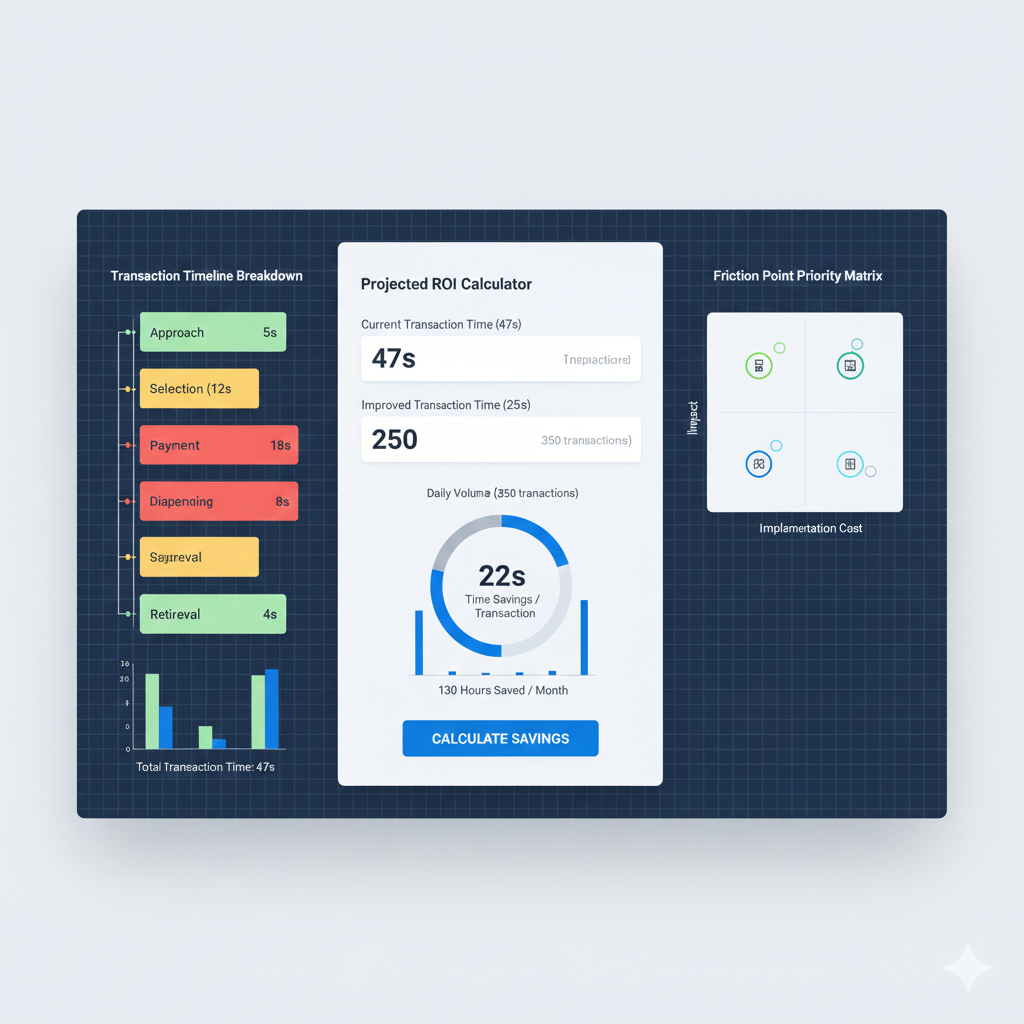
Create a detailed transaction map of your highest-traffic machine. Time each stage: approach, evaluation, selection, payment, dispensing, retrieval. Identify the three highest-time-cost touchpoints. Those are your primary friction elimination targets.
Test Transparency First:
If you operate traditional coolers, test adding external inventory visibility (even simple LED indicators showing “in stock” vs “out of stock” for top products). Measure conversion rate changes over 30 days. Transparency is the lowest-cost friction elimination with the highest immediate impact.
Optimize Selection Interface:
If using alphanumeric codes, map how many selection errors occur per week (wrong code entries, customer hesitation, abandoned selections). Calculate what a touchscreen or simplified button layout would save in lost transactions and customer frustration.
Implement Guaranteed Dispensing:
Modern vending machines with optical sensors that confirm product delivery cost 8-12% more than traditional models but reduce customer service calls by 60%. Calculate your current monthly support costs related to “product didn’t dispense” issues. The sensor upgrade often pays for itself in 4-6 months through support cost reduction alone.
Pilot Automated Payments:
If you have a captive audience location (office building, campus, hospital), test app-based automatic payment where customers link their account once and subsequent purchases charge automatically based on product removal. Track the conversion rate differential between automated and traditional payment users.
Measure Everything:
Install basic analytics if you haven’t already. Track: average transaction time, peak hour throughput, payment failure rate, product out-of-stock frequency, and abandonment patterns (people who approach but don’t transact). You can’t eliminate friction you can’t measure.
Iterate in Weeks, Not Years:
Frictionless transformation doesn’t require total replacement of your fleet. Test friction elimination upgrades on your three highest-volume locations first. Measure performance changes over 60-90 days. Expand friction reduction to additional locations only after proving ROI on your pilots.
The vending industry doesn’t have a payment problem. It has a friction problem that we’ve been solving with payment technology because payment vendors have larger marketing budgets than operational efficiency consultants.
Frictionless vending means asking a different question: not “how should customers pay?” but “how many touchpoints can we eliminate entirely?” The answer determines whether you’re operating a modern micro-retail system or managing an increasingly obsolete cash box with a digital payment terminal.
The operators who understand this distinction will own the next decade of vending growth. The operators who don’t will keep upgrading payment systems while watching conversion rates stagnate.
Friction is the tax on every transaction. Frictionless is the competitive advantage.
This is Why the Future of Micro-Retail is Frictionless.
Learn more about the adavantages of smart coolers: Smart Coolers vs. Traditional Vending