
How I Landed My First Location With Zero Proof
When you have no experience, you do not compete on experience. You compete on
everything that experience cannot fake.
That realization became the hinge that opened my first door.
I didn’t have locations. I didn’t have revenue. I didn’t have case studies. What I did have was the
ability to press hard on the variables that most vendors ignore. Four vectors in particular became my leverage. This is how I landed my first location with zero proof:
1. Out-Offering the Market
Most vending operators walk into meetings selling hardware. I walked in selling outcomes.
Instead of saying, “Here’s my machine,” I said, “Here’s how your members will use it, why they’ll trust it,
and how it will actually improve their experience.”
Hosts don’t want a vending machine. They want fewer complaints, happier members, and less friction.
So I stopped competing on machines and started competing on problem removal.
The Beginner Tax
As a beginner, you have to pay something I like to call the “beginner tax.”
You might have to offer a higher percent commission than the next vendor. You might have to give them a higher
sign-on bonus. You might have to offer lower prices. You will basically have to just pay more up front than an
established vendor who has more experience than you.
Having a good location is important, obviously. But that is easier said than done. Why do you think you deserve
to have a $2,000/month location right off the bat with zero experience? It’s going to take time to build up to that.
So starting out, you will have to pay this tax.
2. Weaponizing Emerging Technology
At the time, there was virtually zero smart-cooler penetration in my area. Everyone was still pitching legacy combo machines.
That mattered.
New technology doesn’t just perform differently — it signals differently. It reframes the conversation from “another vending guy”
to “first mover.”
I wasn’t just offering snacks. I was offering my market a preview of the future. And nobody competes well against the future.
Why Smart Coolers Were My Leverage
I have seen many vending machines over the course of my living here in Montgomery County, and not once have I seen smart coolers being used.
This was my leverage. My advantage. But I knew it wouldn’t last — I had to act quickly.
3. Client Acquisition as a Design Process
Before I ever met a potential host, I built custom planograms for their specific location.
Not templates. Not cookie-cutter decks.
What I Designed the Planograms Around
- Their demographic
- Their foot traffic
- Their location type
Why Custom Planograms Work
This did two things:
- It demonstrated that I wasn’t here to drop a machine and disappear.
- It forced the host to visualize their members using their machine.
Once someone starts mentally stocking your machine, you’ve already won half the sale.
These planograms showed the client that I was taking their needs and wants into consideration before we even met.
Speaking of client relations, here is a post where I explain how to acquire clients in 2026: Top 3 Ways to Get Vending Machine Clients in 2026
4. Proving Dedication When You Have No Proof
Here’s the part most people would call unnecessary.
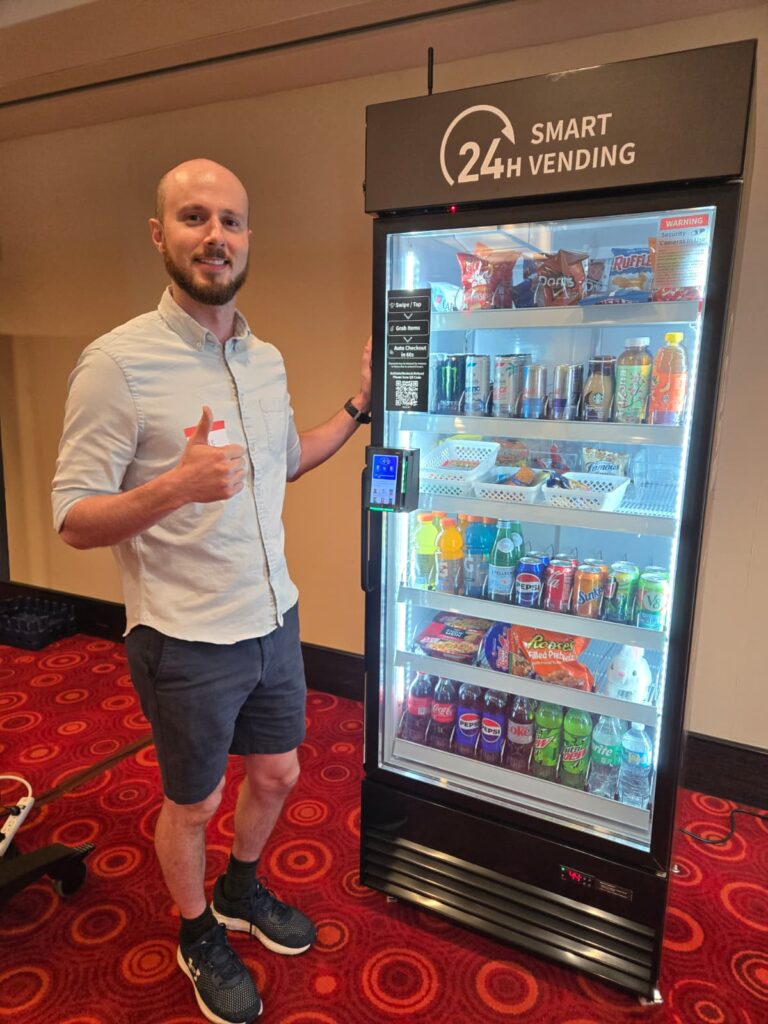
I had never touched a smart cooler in person. My mentor in Tampa was hosting a seminar. I woke up one day at 2:45 a.m.
and drove 14 hours and 37 minutes to Florida just to stand next to one.
I took a picture of myself beside that machine.
Then, when I met my first real prospect, I showed them that photo and told them exactly why I made that drive.
Not for vanity. For conviction. For dedication.
Even if it only moved the needle 1%, that person would walk away thinking:
“This guy is serious.”
And when you have no proof, seriousness is proof.